The Bloomerangas Method™
The only gamified facilitation method for clarity, alignment, and creativity.Trusted by facilitators working with Nike, IKEA, Vinted, Web Summit, KTU.
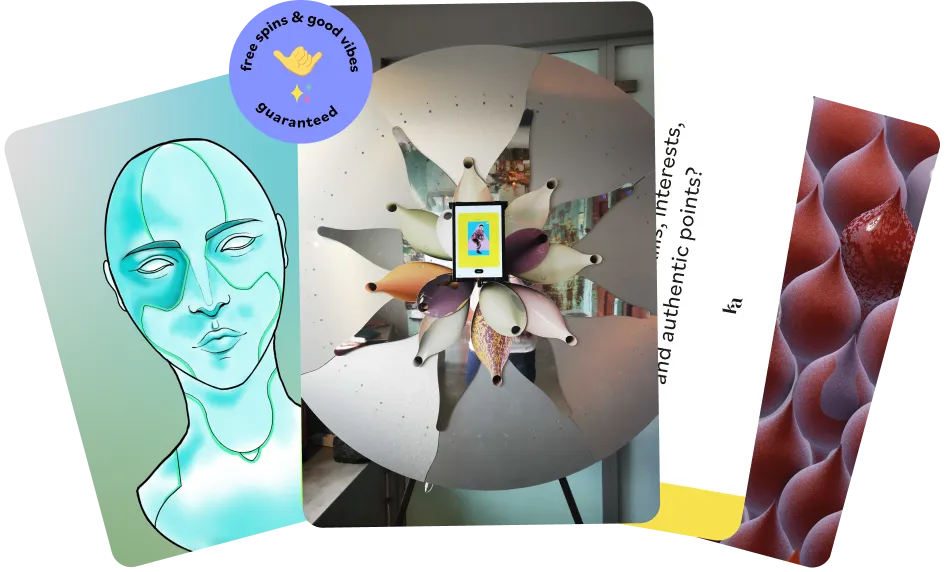
Bloomerangas brings together methods inspired by
brand development, design thinking, applied psychology, and gamification into one cohesive digital-physical facilitation toolkit to unlock creativity and insight.
Whether you’re running brand strategy sessions, innovation workshops, or team retreats — Bloomerangas helps think deeper, align faster, and move forward with confidence.





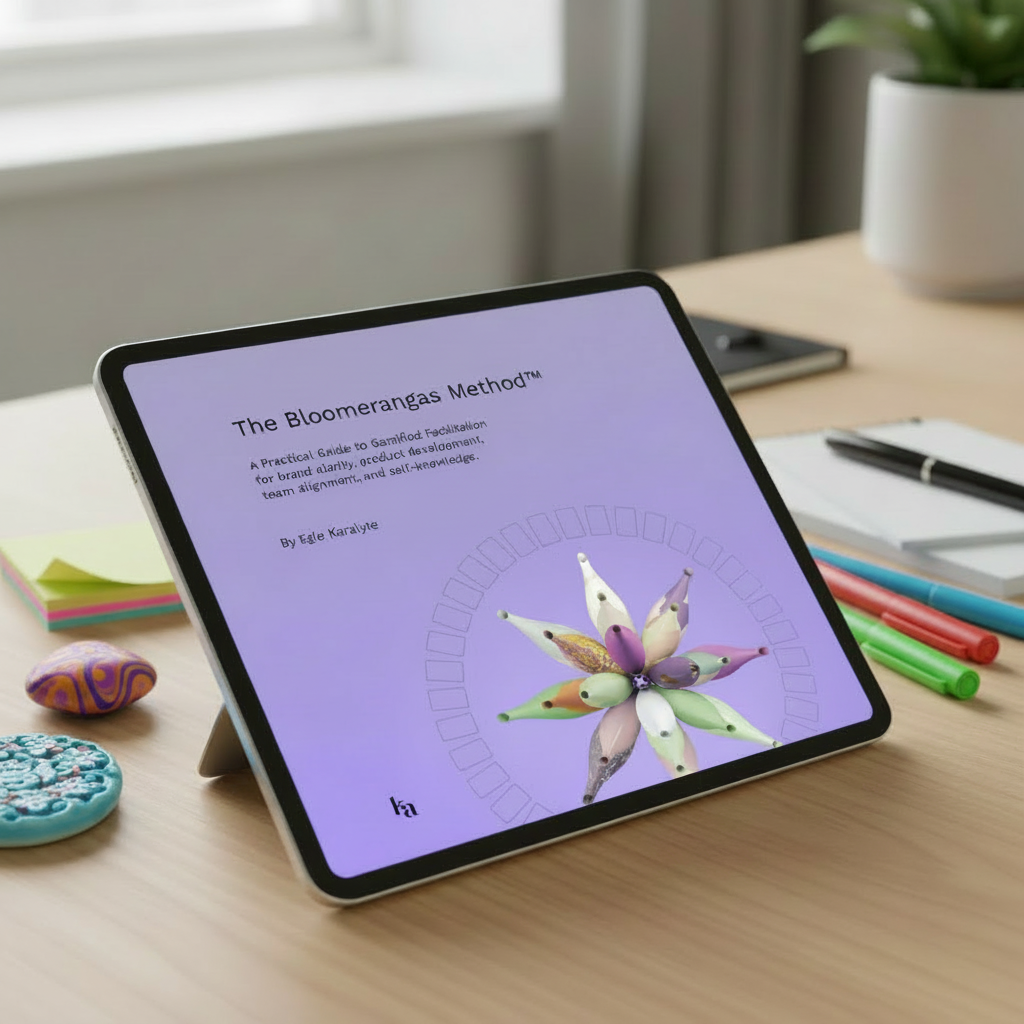
E-BOOK
The Bloomerangas Method
Explore our practical guide to gamified facilitation for clarity, alignment, and creativity.
It includes a synthesis of our lessons learnt from running workshops over the past 20 years.
What the Method Is
At its center, the Bloomerangas Method rests on a single observation: people already hold the clarity they are searching for.
A brand knows what it stands for. Its team simply has not found the conditions to surface and agree on it. A person knows what matters most to them. They have not had the space to hear themselves say it out loud. A team knows where the friction is. No one has created the environment in which it is safe to name it.
The method creates the conditions under which the answers that are already present become visible, articulable, and shared.
It does this through a gamified structure — a combination of a physical game board, modular card systems, and a facilitation philosophy — that replaces the traditional workshop format entirely. There is no slide presentation. There is no workbook. There is no facilitator-led discussion where the loudest voice wins.
There is a gamified experience. And this experience does what a good game always does: it gets people out of their heads, into the present moment, and genuinely thinking together.
The Four Use Cases
The same system, the same toolkit, and the same facilitation philosophy power four distinct use cases. The facilitator shifts the card sequence, the questions, and the lens — the method does the rest.
Self-Crystallization
For individuals who need to clarify who they are, what they stand for, and what they want to create next. The method works as a structured mirror — surfacing values, strengths, desires, and limiting beliefs that the person already holds but has not yet been able to articulate. Effective for founders, leaders, coaches, consultants, and anyone at a point of transition.
Brand Development
For brands that need to define or realign their mission, vision, purpose, positioning, and core message. The method works equally well with leadership teams, whole-company workshops, or solo founders — because the goal is always the same: to get the people who know the brand best into the conditions where they can finally say what they actually think, and agree on what is true.
Team Building
For teams that need to move from coexistence to genuine coherence. The method surfaces each individual’s contribution, aligns the group around a shared direction, and creates the kind of trust that only comes from being genuinely known by the people you work with. Not through a trust exercise — through a shared experience of thinking well together.
Product Development
For teams working on a new product, service, or creative concept who need to move from scattered ideas to a clear, aligned direction. The method creates the conditions for divergent thinking to happen fast and convergent thinking to happen honestly — surfacing what the team actually believes about what they are building, who it is for, and why it matters.
How It Works: The Structure
The method has three physical and structural layers that operate simultaneously in every session.
The Game Board and Movement System
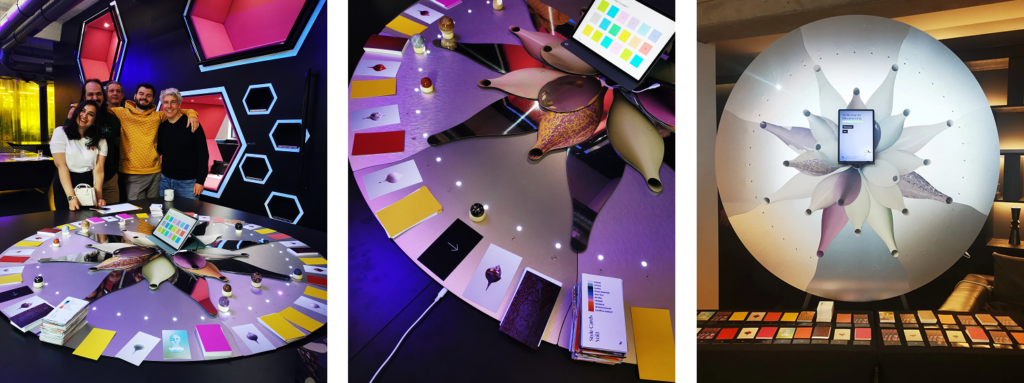
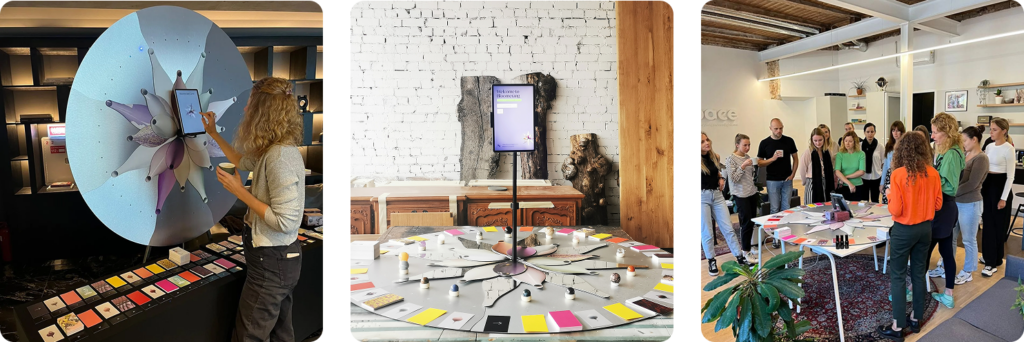
The Bloomerangas board is the physical container of the workshop. Participants move through the board using a dice (analog version) or a tablet-driven spinner (digital version, supporting groups of any size up to several thousand). The movement is not decorative — it is the mechanism that keeps energy moving, prevents any single person from dominating, and ensures every participant engages with the content.
The board can be configured with or without a winner mechanic. The leveled, winner-based version introduces movement cards, controller rights, and a currency system — creating competitive dynamics that work particularly well for team building. The co-creation version, without a winner, sustains an open generative flow better suited to brand crystallization and self-reflection.
The physical act of moving through the board does something a discussion cannot: it makes the workshop feel like an adventure rather than a meeting. People arrive not knowing what to expect. The curiosity that creates is not incidental — it is the psychological precondition for everything that follows.
The Card System
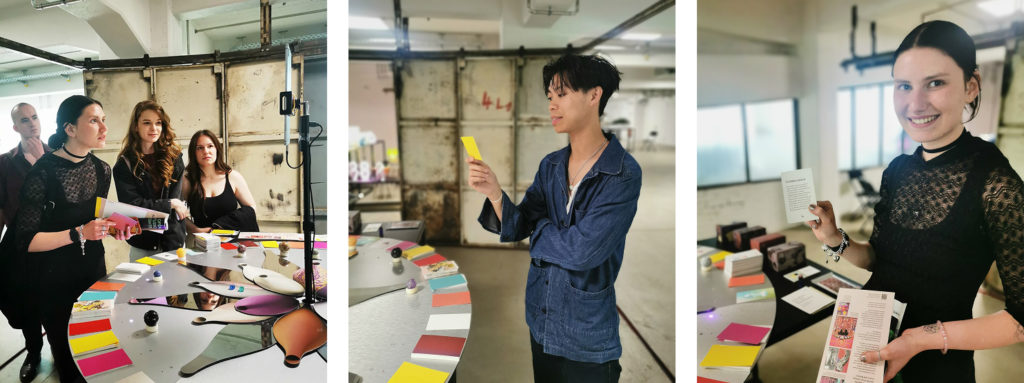
The card system is the content engine of the method. A curated ecosystem of card sets — each serving a different cognitive and strategic function — is sequenced by the facilitator to fit the workshop goal. No two workshops use the same sequence. The facilitator selects, arranges, and layers the cards to create the invisible structure that guides the session toward its outcome.
The card sets include:
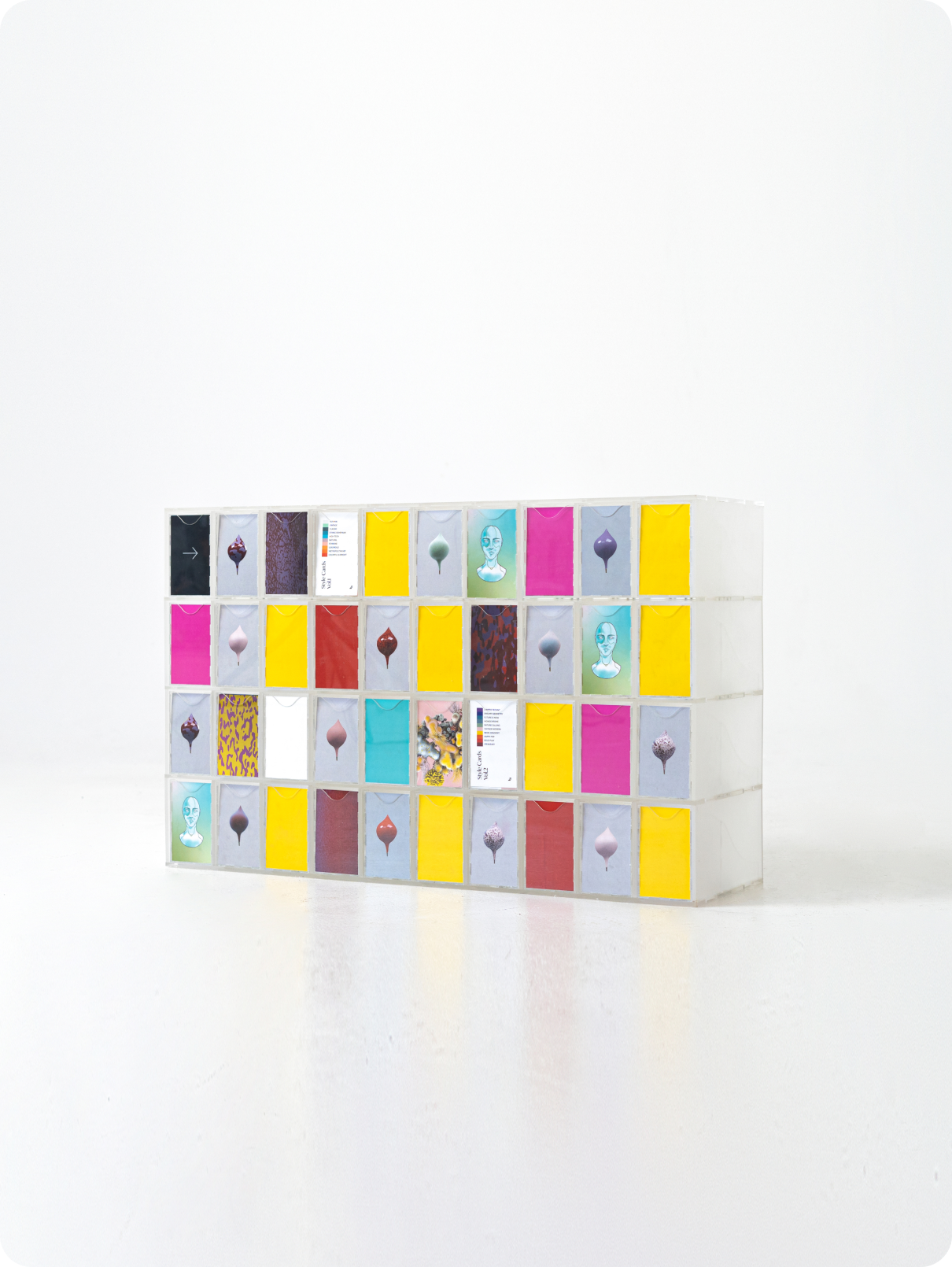
- Self-Reflection Cards — deep questions from all dimensions of life and work, designed to surface values, desires, fears, and limiting beliefs. Used in self-crystallization, team building, and as entry points in brand work.
- Superpower Cards — 26 creator qualities that high-performance individuals and teams embody. Used for self-identification, team mapping, and gifting — participants identify their own superpower, or recognize and give a superpower card to a colleague.
- Brand Strategy Cards — strategic questions that cover mission, vision, positioning, competitive landscape, and unique value. The backbone of brand crystallization workshops.
- Next Generation Ideas Cards — mega trends and innovation signals from across industries. Used to locate the brand within the broader global context and expand the frame of reference.
- Design Cards — curated contemporary design works from creators worldwide, organized by visual theme. Used to build mood boards, articulate aesthetic direction, and surface what cannot be said in words.
- Creative Flow Cards — nine stages of any creative process, from initial impulse through experimentation, crystallization, and into growth. Used to identify where an individual or project currently is, and what is needed to move forward.
- Word Cards — four sets covering brand archetypes, tone of voice, personality traits, and style characteristics. Used as vocabulary tools when participants know what they feel but cannot yet find the words.
- Avatar Cards — imaginary archetype characters created in collaboration with artists and musicians. Used as brand persona inspiration, archetype exploration, and aspiration tools.
- Content and Marketing Cards — communications and content strategy prompts. Used in brand workshops to extend from identity into expression.
- Gamification Cards — movement cards, controller cards, currency, and level cards. These add the game dynamics that make the system engaging for large groups and long sessions.
The Brand Canvas
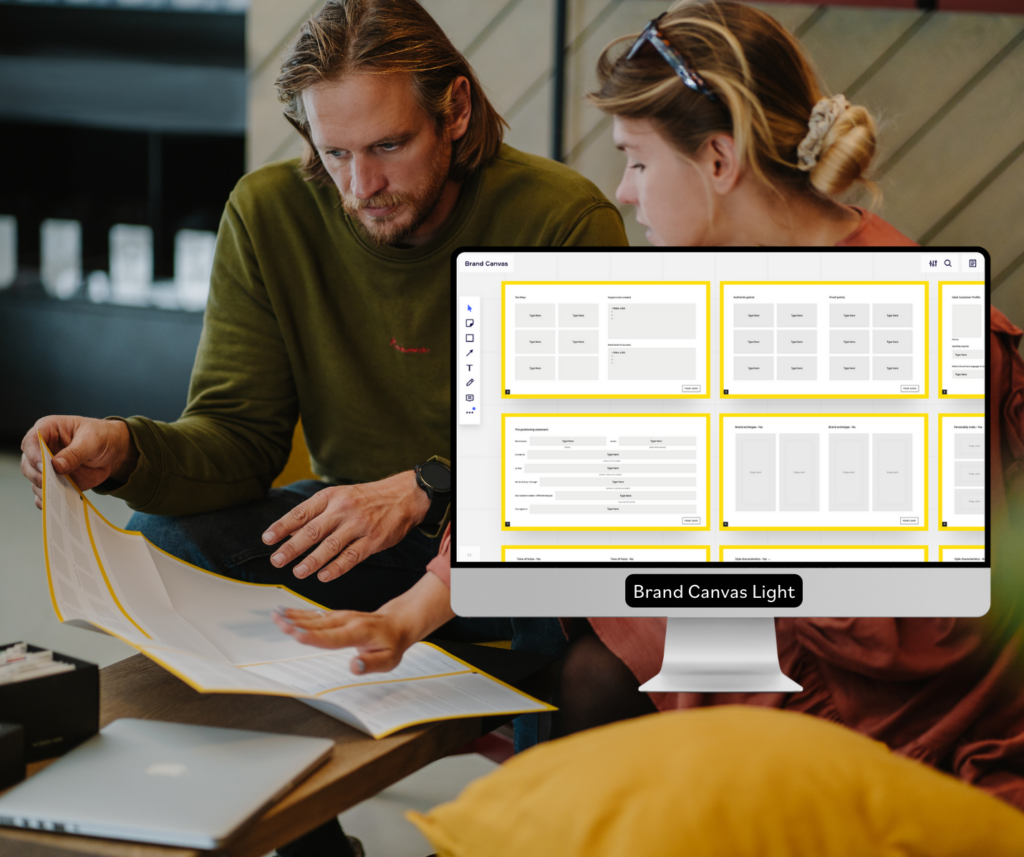
The Brand Canvas is the consolidation tool — the center of gravity of the entire system. It is present in every use case, in every workshop, in every format. As the game progresses, answers, insights, and decisions are captured on the Brand Canvas, either written directly or through sticky notes.
At the end of the workshop, the Brand Canvas is not a summary. It is the artifact. It reflects everything that surfaced during the session — the values, the direction, the core message, the personality — organized into a single visual that the group can look at together and recognize as true.
The Canvas is then photographed, printed in A2 format, and delivered to the client digitally and physically. It becomes a strategic reference document — something teams hang on walls, return to in meetings, and use as the foundation for everything built afterward.
How a Session Moves
A Bloomerangas session does not follow a fixed script. The facilitator reads the room, adjusts the pace, and makes decisions in real time. But every session moves through four recognizable phases — each with a distinct purpose, a distinct emotional quality, and a distinct set of tools.
Opening — enter the game
The session begins by establishing that this experience will be different. Participants are introduced to the tools without being told exactly what will happen. Curiosity is activated deliberately. A first card draw or spin — often from the Superpower or Self-Reflection deck — establishes the mode: this is playful, personal, and safe to engage with honestly.
Tools: Superpower Cards, Self-Reflection Cards, Avatar Cards, spin-based opening activities.
Sign of success: People are visibly relaxed. The energy has shifted from polite attendance to active engagement. Someone has laughed.
Exploration — generate through the game
The core of the session. Participants move through the board, draw cards, answer questions, and do exercises — individually, in pairs, or as a group — depending on the facilitator’s design. The facilitator is not directing answers. The facilitator is listening: tracking patterns, noting repeating themes, catching the phrases that land differently from everything else. These are the seeds of the final synthesis.
Between card draws, the facilitator introduces additional exercises that break the rhythm and introduce a new dynamic — a mood board exercise, a superpower exchange, a role-play, a question passed from one player to another rather than answered by the person who drew it. The session is never just card-after-card. The facilitator is always adjusting the river’s direction without controlling its flow.
Tools: Brand Canvas (generative sections), Brand Strategy Cards, Self-Reflection Cards, Design Cards, Creative Flow Cards, Word Cards, Avatar Cards, Next Generation Ideas Cards.
Sign of success: Participants are saying “I’ve never thought about it that way” or “I didn’t know we disagreed about that.” The facilitator’s notes are full.
Synthesis — connect the dots
As the session nears its end, the facilitator brings everything that has surfaced onto the Brand Canvas. This is not a summary. It is a co-recapping — the facilitator names what they heard, checks it against what participants recognize as true, and together the group refines it until the canvas holds something everyone can stand behind.
The test of a successful synthesis is not whether the output is correct. It is whether every person in the room believes it is theirs.
Tools: Brand Canvas (synthesis sections), Word Cards, structured ranking or voting activities, Brand Core Tool.
Sign of success: The output on the canvas is visible and shared. The test is not whether it is correct — it is whether every person in the room believes it is theirs.
Close — leave with something tangible
The session ends with a structured closing that reinforces what was built and makes the next steps concrete. Participants leave not with notes from a meeting, but with a visible artifact, a shared experience, and clarity they did not arrive with.
Tools: Brand Canvas (completed), session summary, next steps canvas, closing reflection card prompt.
Sign of success: Every participant knows what was decided, what happens next, and who owns it. The canvas is something they want to take home.
The Role of a Facilitator
The tools are precise. The structure is clear. Neither produces transformation on their own.
In the Bloomerangas Method, the facilitator is not a host or a moderator. The facilitator is an instrument — as important to the outcome of the session as any card, canvas, or game mechanic in the room. And like any instrument, the facilitator must be prepared, calibrated, and in good condition to perform.
The facilitator’s primary task is listening — not passive listening, but active, pattern-tracking attention that catches what the client is saying beneath what they are saying. The facilitator notices when the same idea comes up three times in different words. They notice when a person’s body language contradicts their answer. They notice the moment when something true surfaces in the room and needs to be reflected back before it disappears.
The facilitator is a mirror. Their job is to reflect back what the group is expressing until the group can see it clearly enough to own it. This means asking open questions rather than leading questions. It means not inserting their own interpretation of what the client means. It means allowing the client to find their own answer — and trusting that the answer is already there.
It also means arriving to every session in a state that makes this possible. A facilitator carrying their own emotional noise — stress, agenda, the desire to be impressive — cannot hold the quality of attention the method requires. Bloomerangas facilitators prepare before every session: mentally, energetically, and practically. They arrive as a clear channel, ready to be fully present to what the group brings.
This is why the Bloomerangas Method is a training program as much as a toolkit. The tools are learnable in hours. The facilitation is developed over time — through workshops, through practice, through the kind of self-knowledge that only comes from having done this work on yourself first.
Bloomerangas Facilitator Certification is available for practitioners who want to learn, practice, and be accredited in the Method.
What makes this different
The global facilitation market offers many tools and many methodologies. Here is the honest comparison:

The Bloomerangas Method occupies territory none of these own: the intersection of brand strategy, gamified facilitation, and human transformation — unified by a coherent philosophy of what it means to help a person, a team, or a brand return to itself.
It is the only method that treats clarity as something to be surfaced, not constructed. The only method where the game is not a container for the real work — it is the real work. And the only method that trains facilitators to develop themselves as instruments alongside the toolkit they carry.
Who This is For
The Bloomerangas Method is designed for practitioners who bring domain expertise to their clients and want a facilitation system rigorous enough to match it.
Brand strategists. Coaches. Consultants. Organizational development practitioners. Innovation leads. Creative directors who have moved into facilitation. Anyone who runs workshops and wants to produce something more lasting than a good conversation.
It is particularly well-suited for practitioners who want to stand out in a market where most facilitators are working with the same whiteboard and sticky-note toolkit — and who are looking for a methodology with philosophical depth, physical distinctiveness, and a training pathway that develops them as practitioners over time.
Where It Came From
The Bloomerangas Method was not designed at a whiteboard. It was discovered by Egle Karalyte through fifteen years of running workshops — for startups, for global brands like Adobe, Google, Nike, and Vinted, for incubators in South America, North Africa, the Middle East, and across Europe — and noticing, every time, the same gap.
The content of the workshops worked. The questions were good. The strategy was sound. But something about the format — the slides, the workbooks, the structured exercises — put people into a mode that was exactly wrong for the goal. They became careful. Performative. They gave the answers they thought were expected.
The most useful things — the real values, the genuine disagreements, the half-formed idea that turned out to be the core of everything — only emerged when something shifted the energy in the room. When people relaxed. When they stopped trying to get it right and started actually thinking.
The Bloomerangas Method is what happens when you build an entire facilitation system around that shift — and make it reliable, repeatable, and transferable to other facilitators.
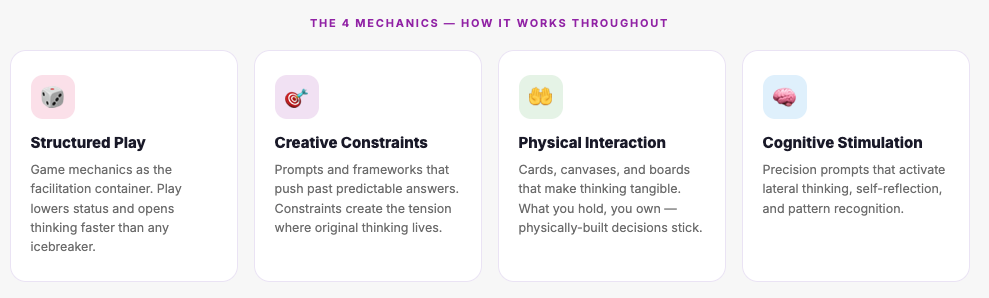
Why It Works: The 4 Mechanics
For those who want to understand the method beneath the method — here is what is happening cognitively and psychologically in every Bloomerangas session.
Mechanic 1: Structured Play
When a group is playing — even briefly, even formally — something shifts. Status drops. Defensiveness lowers. Thinking opens.
This is not an impression. It is documented. Psychologist Jaak Panksepp’s research on the brain’s PLAY system identified play as one of the primary emotional operating systems in mammals — a neurological state that reduces threat responses and activates exploratory behavior. Stuart Brown’s three decades of research at the National Institute for Play established that play is not a luxury or a break from serious work — it is the condition under which the brain produces its most creative and adaptive thinking.
In organizational settings, researchers at MIT’s Human Dynamics Laboratory found that the single strongest predictor of team performance was not intelligence, seniority, or experience — it was the quality of informal, energized interaction between team members. Play creates that interaction reliably and fast.
The Spinboard, card decks, gemstone pawns, and timed exercises are the delivery mechanism for this state. When a participant draws a card, spins a wheel, or moves a piece, they engage through a game mechanic — which means they stop performing and start thinking.
In a Bloomerangas session, play is not a warm-up. It is the primary mechanism. The game is the workshop.
Mechanic 2: Creative Constraints
A blank page is the enemy of original thinking. This runs counter to the intuition that freedom produces creativity — but the evidence is consistent and substantial.
Psychologist Patricia Stokes, in her study of creative constraints across artists including Monet and Picasso, found that the artists’ most innovative periods were defined not by freedom but by self-imposed limitations that forced them to find genuinely new solutions. Teresa Amabile’s research at Harvard Business School on creativity in organizations found that vague, open briefs consistently produced safer, more conventional thinking than structured, bounded ones. Catrinel Haught-Tromp’s work on the “green eggs and ham” hypothesis demonstrated that creative constraints — far from limiting output — force the brain into associative pathways it would not otherwise access.
When a participant is forced to describe their brand using only three archetype cards, or to define their value proposition in one sentence using a specific template, they cannot fall back on vague language or familiar talking points. The constraint forces precision — and precision is where clarity lives.
Every card deck, canvas, and workshop template in the Bloomerangas toolkit is a constraint mechanism designed to push participants past their first — and most predictable — answer. The toolkit is built entirely on this principle.
Mechanic 3: Physical Interaction
The body is part of the brain. This is not a metaphor — it is the central finding of embodied cognition research, one of the most significant developments in cognitive science over the past thirty years.
Psychologist Lawrence Barsalou’s foundational work on grounded cognition demonstrated that the brain does not process abstract concepts independently of the body — it simulates them using sensorimotor systems. Meaning is literally constructed through physical experience. Researchers Sian Beilock and Thomas Carr showed that physical interaction with objects enhances both retention and understanding of the concepts those objects represent. A 2010 study by Joshua Ackerman, Christopher Nocera, and John Bargh published in Science found that the physical weight and texture of objects directly influenced participants’ judgments and decisions — people holding heavier clipboards rated job candidates as more serious; people working at rough surfaces made harsher social judgments.
In workshop terms: a decision made while touching and arranging physical objects feels more owned, more considered, and more memorable than one made by clicking on a screen. This is not a minor distinction — it changes what people do with the output after the session ends.
The Spinboard, gemstone pawns, physical card decks, and printed Brand Canvas are all expressions of this mechanic. The physicality of the toolkit is not aesthetic preference. It is what makes the session’s output feel like something the group built — not something that happened to them.
Mechanic 4: Cognitive Stimulation
Every prompt, card, and exercise in the Bloomerangas toolkit is designed to activate specific cognitive states — curiosity, lateral thinking, pattern recognition, self-reflection — that produce more original and meaningful outputs than standard brainstorming or discussion.
Standard workshop prompts (“What are our strengths?”) activate retrieval of known information — what psychologists call System 1 thinking, described by Daniel Kahneman in Thinking, Fast and Slow as fast, associative, and heavily biased toward familiar patterns. Bloomerangas prompts (“Which of these twelve archetypes feels most foreign to your brand — and why?”) activate what Kahneman calls System 2 thinking — deliberate, effortful, and capable of producing genuinely new conclusions.
Psychologist Mihaly Csikszentmihalyi’s research on flow states found that the optimal condition for peak creative performance is a precise calibration between challenge and skill — too easy and the brain disengages, too difficult and it freezes. The Bloomerangas toolkit is designed to operate in exactly this zone: prompts that are challenging enough to surface something new, structured enough to give participants the scaffolding to articulate it.
Research by Adam Grant at Wharton on original thinking further found that the people who generate the most creative ideas are not those who think the fastest — they are those who stay in a state of productive uncertainty for longer before converging on a conclusion. The Bloomerangas session arc is designed around this finding: the Exploration phase deliberately extends divergent thinking past the point where most facilitated discussions would close it down, creating the conditions for genuinely original synthesis to emerge.