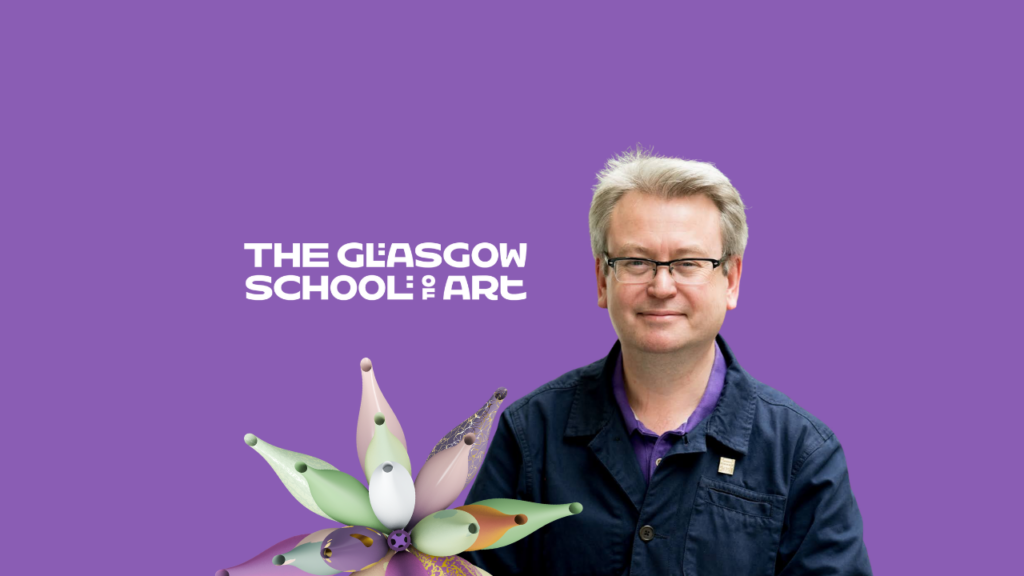
Stephen Bottomley is Professor of Jewellery Cultures and Innovation and Head of the School of Design at Glasgow School of Art, where he has led the school since 2022.
He trained as a goldsmith and jeweller, is a Freeman of the Worshipful Company of Goldsmiths, and his own work is held in collections including the British Museum and National Museums Scotland. Before Glasgow, he led jewellery and metalwork departments at Birmingham City University, Edinburgh College of Art, and Sheffield Hallam University, and in 2019 his teaching and research work earned a Queen’s Anniversary Award for Higher Education.
His research draws on an unusual comparison: the overview effect, the shift in perspective astronauts describe when they see Earth from space, and what it can teach makers about seeing familiar materials differently.
In this conversation, Stephen traces that idea back to his own research on early computerization and craft, explains why he thinks most AI is still disappointing rather than dangerous, makes the case for touch and haptic learning as the real foundation of design education, and describes a project that turned a salvaged, sixty-year-old church roof into new work.
Let’s dive in.

A New Way of Seeing
Bottomley grew up in the Space Age, watching television shift from black and white to color and the moon landing arrive as what he calls a genuine epoch event. That early fascination with space resurfaced decades later as an unlikely research lens: the overview effect, the profound shift in perspective astronauts describe when they see Earth, borderless, from space.
The idea traces back further still, to his own master’s research at the Royal College of Art between 1999 and 2001, on how early computerization was beginning to change the way craftspeople made objects. He returned often, during that period, to a line from Marcel Proust.
The royal voyages of discovery consist not of seeking new landscapes, but having new eyes.
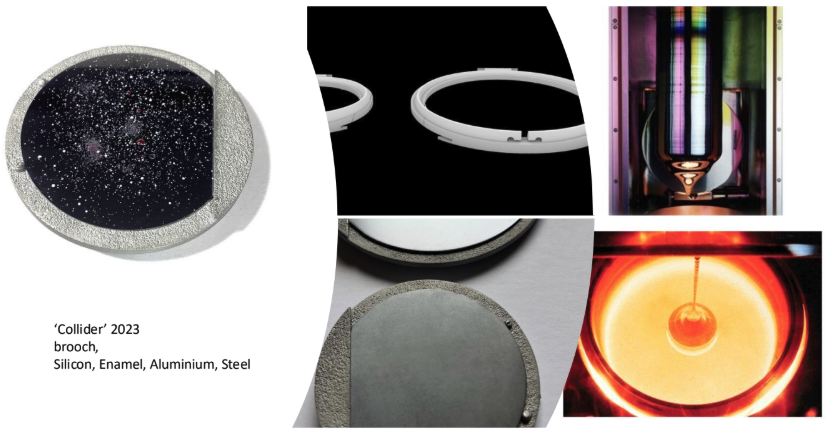
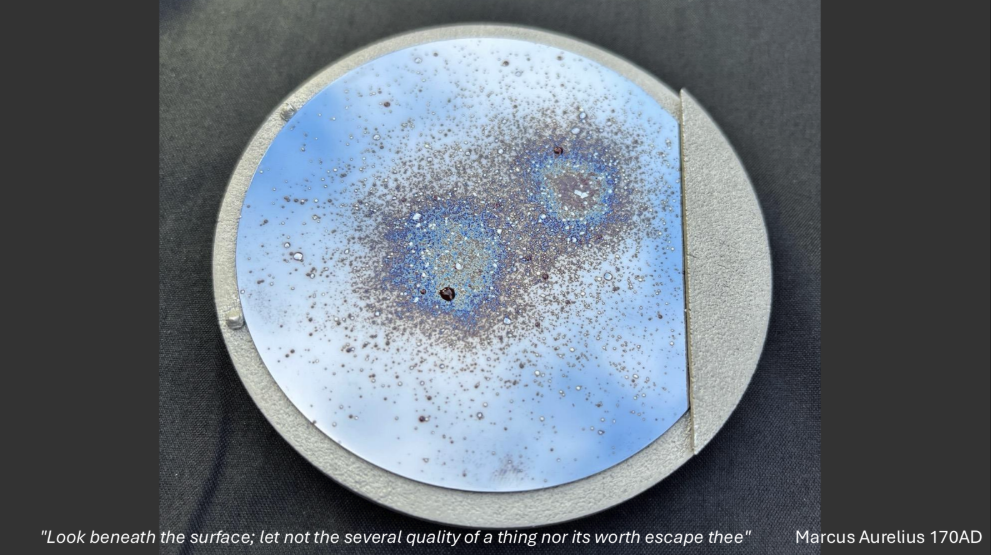
For Bottomley, that’s the real subject, not travel for its own sake, but a shift in how a maker looks at what’s already in front of them. Twenty-six years on, his own work engages far more with science, technology, and new materials, and treats computerization as one tool among many rather than the main event. He might use an ancient technique alongside a contemporary digital one in the same piece, whichever one lends him a new perspective on what he’s making.
Where AI Actually Falls Short
Craft education, in Bottomley’s view, sits in obvious tension with the current moment in AI, and he’s candid about where that tension comes from. AI is a genuinely powerful tool, he says, and understanding how to use it properly and responsibly matters. But its environmental cost, its energy demands, and the unresolved questions around whose creative work it was trained on are all real, and worth taking seriously as designers and makers.
His deeper objection is more fundamental. Design education, at its best, is meant to help a person contribute something original, something that adds to the wider sum of human knowledge rather than simply recombining what already exists. Most AI, on that measure, still falls short.
So much of AI is disappointing at the moment, because there’s a reliance on what’s already out there. It’s not really intelligence, because it’s not creating anything new, apart from a limited vocabulary of what’s available.
That doesn’t make the tool useless. Bottomley uses AI himself for ordinary tasks, summarizing a hundred emails at once, for instance, while staying alert to how often it still gets details wrong. Anything that cuts through the sheer volume of bureaucracy and paperwork that fills modern working life, he says, is going to be a good thing. The distinction he keeps drawing is between AI as an assistant for the tedious parts of the job and AI as a substitute for the parts that are supposed to be original.
Touch Comes First
Ask Bottomley what has to be in place for creative education to work, regardless of discipline, and he starts with the body. Touch and haptic experience come first: handling different tools, working across different materials, learning to draw not just as a technical skill but as a way of truly seeing and transcribing the world. Drawing, in his account, is the pivotal starting point for nearly every program the school runs.
That physical, material engagement only really comes alive in a shared studio. Departments, technical staff, students, and faculty share space at Glasgow School of Art, and that proximity does real pedagogical work: people critique each other, form close friendships, and become each other’s toughest critics in the same breath. Learning to take that kind of feedback well, Bottomley says, is itself a core part of a design education.
The great potential that collaboration has in person, where people work as a team to actually solve something, and there’s actually outcomes at the end of the day.
He calls this kind of in-person, collaborative studio work classic teaching, something a single online session on a device can’t replace. Both have value, he says, but a culture of doom-scrolling and constant device use risks isolating people from exactly the kind of in-person collaboration that makes creative breakthroughs possible.
A Church Roof Becomes Jewellery
Around 1900, some 75 designers working in what became known as the Glasgow Style moved fluidly between disciplines. Their own descriptions of themselves read strangely modern: silversmith, enameler, and tapestry worker, all at once. Bottomley has tried to rebuild something of that same cross-disciplinary instinct since joining Glasgow School of Art in 2022, when he asked staff to propose collaborative research clusters that would each span at least two departments. More than ten proposals came in. Some faded, others grew into full research programs with their own conferences, touring exhibitions, and research students.
Bottomley leads one of them himself, called Drawing Threads, which pairs the jewellery and silversmithing department with textiles and embroidery. Its most striking project so far, ReInspired, gave staff and students metal salvaged from a church spire that had aged outdoors for sixty years, and asked them to work with its existing color and patination rather than melting it down to start fresh. The project has now had three exhibitions, with papers and articles underway to share what the team learned.
We’re always evolving and changing, but it’s really important to understand that that change is a process, and that we can be in command of that kind of process and that direction.
The instinct behind it, recycling material rather than discarding it, echoes something much older in the craft itself: the practice, going back generations, of capturing gold dust and offcuts from the bench and remelting them rather than reaching for something new.
Real Gold, Grown Diamonds, and the Price of Materials
Bottomley has spent a career working with precious metals, and he’s watched the debate over synthetic versus mined materials shift shape without ever really going away. Lab-grown diamonds are, at a chemical level, identical to ones that formed underground over millions of years, yet marketing campaigns still lean hard on the romance of the ancient, naturally formed stone.
He thinks that romance obscures the more urgent story: the working conditions behind mined gemstones, the tons of earth displaced for a single gram of metal, and the environmental damage left behind. Rather than treating lab-grown materials as somehow fake, he’d rather call them what they are, industrially made, and see that as a mark of innovation rather than compromise.
Understanding that they are industrially made, and actually that’s not necessarily a bad thing. That shows the innovation and development of science alongside art.
The economics have become impossible to ignore either way. Gold and silver prices are both at historic highs, high enough, Bottomley says, that they’re pricing some students out of working with the metals a jewellery education has traditionally been built around. That’s pushing the field toward materials that weren’t originally chosen for the techniques craftspeople have spent generations refining, which opens its own question: how do old techniques translate to a new material, and what becomes possible that wasn’t before?
Patience, Failure, and Finding Your Own Style
Asked what it actually takes to move from copying a technique to developing a genuine personal style, Bottomley starts with patience, plainly, the willingness to fail once, twice, three times, and keep going anyway. Sometimes, he says, a person learns more from something going wrong than from getting it right the first time.
Awareness matters just as much: staying present to what a given action is actually doing to the material in front of you, rather than working on autopilot. And technical manuals, however useful, aren’t gospel. Stepping back from the documented way of doing something and trying an alternative isn’t disrespectful, in his view, it’s how craftspeople actually test and extend what’s already known.
That sense of experimentation and imagination and innovation are really important characteristics as well, I think, for crafts.
Bottomley connects that willingness to experiment directly to self-discovery: the process of testing a material’s limits is, more or less, indistinguishable from the process of finding out what kind of maker you actually are.
From the Studio to the Real World
Glasgow School of Art is a small, specialist institution by design, around three and a half thousand students across undergraduate, postgraduate, research, and continuing education. That scale hasn’t stopped major companies from queuing up to work directly with students on live projects: product design engineering students recently worked with a pizza oven manufacturer looking to expand its range, a well-known car designer brought students into work on off-world viewing platforms and aviation concepts, and hotel groups have come to the school for help reimagining interiors and repurposing heritage buildings.
Bottomley reads those partnerships two ways: as genuine philanthropy, and as a very practical talent pipeline, companies getting an early look at the designers they’ll eventually want to hire. He also points to the school’s own museum and archive, holding work from graduates and staff going back over a hundred years, as proof of how far a Glasgow School of Art education can carry someone. A busload of American collectors and art jewelry specialists visited campus during the most recent degree show, which was, in his words, phenomenal for the graduating students to have their work examined by people who had spent their careers in the field.
The school also runs a continuing education arm for adult learners and an international foundation program for students building a portfolio or language skills before applying to a degree, on top of an active public exhibition program that invites the wider Glasgow community in. For the students moving through those formative years, whether straight after school or returning to education later in life, Bottomley thinks there’s no better use of the time.
It’s very powerful. It’s the power of making.
Glass in Zero Gravity
Bottomley’s optimism about craft’s future doesn’t stop at Earth’s atmosphere. Researchers are already asking how craft might work in zero gravity, since any long-term human presence on the moon or another planet will likely mean building with whatever materials are actually available on-site rather than shipping them from home. Blowing a small glass sphere in zero gravity has already been done. Scaling that up to genuine habitation-grade structures is a different problem entirely, and one Bottomley finds genuinely fascinating.
He grounds even that far-off scenario in something close at hand: the fact that so much of what once looked like science fiction is now ordinary. Mobile phones were communicators on Star Trek before they were real devices people carried everywhere, holding their health data, their contacts, and far more computing power than anyone imagined at the time.
All these technologies we dream about first, and then they come.
The responsibility that comes with that acceleration, in his view, isn’t optional. Whatever arrives next, from delivery drones to off-world manufacturing, needs to be weighed against its effect on the next generation’s mental health and wellbeing, alongside whatever wealth or efficiency it promises. Getting that balance right, he says, matters more than getting to the future first.
To connect with Stephen Bottomley, find him on LinkedIn. To learn more about the School of Design and its research clusters at Glasgow School of Art, visit gsa.ac.uk.