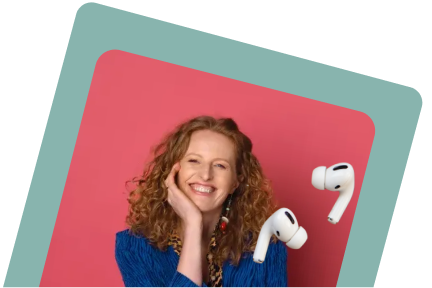
Amanda Schneider is the founder and president of ThinkLab, a market research and strategy firm for the architecture and interior design industry, now the research division of Sandow, the parent company of Interior Design Magazine, Metropolis, and Design Milk. She is the author of the bestselling book Work for What’s Next: Why Workplace Culture Is Failing and How the Next Generation Can Fix It, with a foreword by Deloitte’s Deborah Golden. She also hosts Design Nerds Anonymous, a podcast that sits in the top one percent worldwide. She recently joined The Oprah Podcast to talk about the book as well.
Her research spans every generation in the workforce, but the point she keeps coming back to is simple. We are still operating with analog era norms in a digital speed world, and most of what reads as generational conflict is really everyone catching up to that mismatch, with Gen Z just further along and louder about it. In this conversation, Amanda traces the old and new rules of work, explains why curiosity needs protected time rather than good intentions, names the three things that kill creativity fastest, and makes the case for a loyalty that finally runs both ways.
Let’s dive in.
Listen or watch the full episode on Spotify, Apple Podcasts, or Youtube.
Analog Rules in a Digital Speed World
Amanda’s book opens with a challenge: we are still operating with analog era norms in a digital speed of work. Most workplace habits, from the eight to five schedule to the assumption that being physically present equals being productive, were built for an assembly line economy that no longer describes how most of us work.
The evidence she points to is the Gallup Employee Engagement Index. Everyone remembers the drop in 2020. Fewer people know that engagement kept falling for two more years, by almost as much as that first shock, during a period with nothing as dramatic as a global pandemic to explain it. Amanda reads that as burnout, the cost of pushing back against digital speed with tools built for a much slower world.
“This book challenges that we are still operating with analog era norms in a digital speed of work.”
The book’s other core idea follows from the first. Physical offices gave generations hundreds of years to develop shared social norms without ever having to name them. Digital work removed that shared context, so the norms have to be stated out loud now, not absorbed by osmosis. As Amanda puts it, we can’t fix it if we don’t know it’s broken.
Finding Your Own Era of Intentional Selfhood
One of the book’s central ideas started life with a much blunter name. Amanda borrowed the term “narcissist story” from Hannah Grady Williams, author of Unlocking Gen Z, who used it to describe Gen Z’s willingness to ask for things previous generations simply accepted. Readers reacted badly to the word, so it became chapter three’s “era of intentional selfhood” instead. The premise held.
The chapter invites readers to stop and ask a question most of us never get to ask: when and where do I actually work best? Not because a company policy allows it, but because we finally have the chance to find out. Amanda is a case in point. She calls herself a wicked early riser who can do two hours of real work in about one.
“I am a wicked early riser and I can do two hours of work in about an hour. If I start at 4 or 5 a.m, I put in my binaural beats and I just rock it. If you ask me to do that same level, that same speed, that same cognitive load at 8 p.m, I physically couldn’t do it.”
Most of the public debate about the future of work is still stuck on where people should sit, remote versus return to office. Amanda’s research suggests that’s the wrong axis. Data actually shows more people care about when they work than where they work. Until organizations take that seriously, she argues, even the architects and designers trying to build better workplaces are working with one hand tied behind their back.
Designing Workplaces in a State of Purgatory
ThinkLab sits at an interesting intersection: product design companies on one side, architecture and interior design firms on the other, both trying to design the physical and digital spaces where work happens. Amanda built and scaled the company before selling it to Sandow, and it now functions as Sandow’s research division, working across the industry’s major media brands.
The data from that research tells its own story about where offices stand right now. The corporate workplace category is down almost 20 percent since before the pandemic. That doesn’t mean the office has lost its value. It means people are hesitating on their spend, and where they do spend, they’re chasing quality over quantity: fewer square feet, but nicer ones. Ironically, as employees are freed from a fixed location, the space they do choose comes under more pressure to justify itself. Amanda describes the whole industry as sitting in a kind of purgatory right now, waiting to see what comes next.
Protecting Time as the Real Fuel for Curiosity
Ask an architecture or design firm what’s killing creativity, and digital tools are an easy scapegoat. Pinterest boards, AI generators, and endless reference libraries get blamed for a growing sameness in creative output. Amanda’s research points somewhere else. When her team asked Gen Z designers directly, the answer wasn’t the tools. It was time. One respondent put it simply: he’d rather travel to Milan than scroll a Pinterest board, but time doesn’t allow it.
That reframes the fix. Protecting creativity means protecting time, and the biggest threat to time right now is meetings. Think Lab’s own data shows meetings have tripled since the pandemic, as many leaders tried to rebuild lost togetherness by forcing everyone back into synchronous calls. Few organizations have seriously worked out the balance between synchronous time, where everyone shows up at once, and asynchronous time, where people contribute on their own schedule. The result is a culture where “busy” has become a badge of honor, and where real, focused work often gets pushed to the evening, after the meetings are done.
Amanda sees the same tension playing out with AI. It promises to free up time, but often eats the time it saves.
“I want AI to do my laundry and dishes so I have more time to write and draw, not AI to write and draw for me so I have more time to do laundry and dishes.”
Fear, Busyness, and Certainty
Asked what kills creativity fastest in an organization, Amanda doesn’t hesitate: fear, busyness, and certainty.
Busyness is the one everyone already recognizes, the meetings and constant demands that leave no room to think. Fear runs deeper. Amanda points to the Edelman Trust Barometer and its documentation of trust breaking down across countries and institutions, not just in the workplace. Without shared context between generations, that trust gap widens, and fear keeps people from speaking up in the moment their idea might actually matter.
The third one, certainty, is the one she worries about most in the AI era. Deborah Golden, who wrote the book’s foreword and leads Deloitte’s innovation practice, told Amanda that when she works with major companies on innovation, the obstacle is rarely a lack of new ideas.
“It’s rarely a lack of new ideas that keeps them from moving forward. It happens to be the persistence of old ones.”
AI compounds the problem because it delivers answers with total confidence, and confidence is easy to mistake for correctness. Amanda watches her own teenage sons ask AI a single question and take the single answer it gives them, rather than doing the messier work of checking it against other sources. Teaching people, and organizations, to push back on a confident answer rather than accept it outright may be one of the most important creative skills left to build.
The Goal Is to Win, the Purpose Is to Connect
Amanda hasn’t researched play directly, but a recent episode of a different podcast gave her a framework she keeps returning to: the difference between a game’s goal and its purpose.
“The goal of Monopoly is to win, but the purpose is to connect, think strategically, and enjoy the experience.”
Organizations make the same mistake, she argues, when they optimize so hard for the score, the KPIs, the utilization rate, the billable hour, that they lose sight of the purpose underneath it. She recalls a recent future of work conference where one speaker would present on AI and efficiency, and the next would pivot to the human side of work with a simple recommendation: hold hands. The whiplash between those two visions of the future, one mechanized, one warmly human, is something she thinks the whole industry still has to reconcile. Nobody actually wants a future so optimized that the humanity has been optimized out of it.
What Gen Z Is Actually Asking For
Amanda’s research keeps landing on the same conclusion: Gen Z isn’t asking for anything previous generations didn’t also want. What’s different is the access and context they’ve grown up with.
She points to a moment from freshman orientation at Wake Forest, where the university has tracked the share of incoming students who expect to reach the C-suite since the 1950s. That number sat around 25 percent for decades. Around 2020 it jumped to roughly two-thirds. The parents in the room groan, until the professor asks a follow-up: how many of you include your kids in decisions about family vacations? Most hands go up. Then he asks how many of those same parents were included in that kind of decision by their own parents. Most hands go down.
That’s the pattern underneath everything else. This generation was raised with choices, exposure, and a seat at the table in ways no previous generation was, and then handed a workplace that expects them to sit quietly in a cubicle that may not even make sense for how they work. Two-thirds of Gen Z now say they want a seat at the leadership table. Only six percent say they actually want to move into leadership. Amanda’s explanation is straightforward: they’ve watched what leadership cost their parents, the layoffs after decades of loyalty, the burnout, the marriages strained by too much travel. If that’s what leadership requires, she says, it makes sense they’d rather not sign up for it.
Loyalty, Redefined
The other common complaint about Gen Z is a lack of loyalty, and the data backs it up on the surface. A CareerBuilder survey puts average Gen Z tenure at two years and three months, uncomfortably short for an industry where a single hospital project can take three to five years to complete. But when Amanda’s team asks Gen Z about it directly, they draw a finer distinction.
“It’s not that we lack loyalty, it’s that we lack blind loyalty.”
Their case: inflation is outpacing cost of living raises, while LinkedIn recruiters ping them with 10 percent raises on offer elsewhere at least once a week. Staying put isn’t loyalty in that environment, it’s just inertia. And the same survey puts average baby boomer tenure today at about eight years and three months, itself far shorter than it once was, for exactly the same reason: more access, more options.
Amanda’s answer isn’t to demand more loyalty from employees. It’s to make loyalty a two way street, built on real investment in skill development rather than the expectation that someone stays out of habit. She predicts more “boomerang” employees ahead: people who leave, discover the grass wasn’t greener, and return to an employer that treated them well the first time.
Leadership Means Something Different to Every Generation
Amanda references research from Mark McCrindle’s team in Australia, which asked people across generations what good leadership actually looks like. The answers form a clear progression. For baby boomers, good leaders direct. For Gen X, good leaders coordinate. For millennials, good leaders guide. For Gen Z, good leaders empower.
That shift matters because it’s mutual. Gen Z employees told Amanda’s team, in effect, that trust runs both ways: I will trust you when I feel you trust me. When a generation whose definition of good leadership is empowerment instead experiences direction, the mismatch itself erodes trust, even when the leader’s intentions are good. Amanda points to the return to office mandates framed around mentorship as a clear example: employees show up as asked, and then find nothing about how they’re managed has actually changed. It’s simply the same meeting, now in person.
Building for Whoever Isn’t Yet at the Table
Amanda’s answer for organizations trying to stay relevant to future talent is less about perks and more about who gets a voice. Chapter five of her book explores “shadow boards,” structures that bring in people furthest from the traditional seat at the table to advise senior leadership directly.
The example she returns to most is Gucci’s next gen shadow board, created after the brand noticed its core customer base aging and its sales declining. Rather than promoting younger employees into the corner office, Gucci built a panel to advise leadership on what would resonate with the next generation of customers. During the same period, Gucci grew sales 136 percent while its closest competitor declined by 11.5 percent.
Looking further out, Amanda is already thinking about Gen Alpha, the generation coming up behind Gen Z. Her own youngest son, about to start seventh grade, sits near the top of that cohort. The skill she most wants to build in him isn’t more technical knowledge. It’s the discipline to respect authority without ever handing over judgment to whichever voice in the room sounds most certain, including a machine’s.
Amanda closes on an analogy she uses often: her hope is that the ideas in her book eventually sound as obvious as it now sounds ridiculous that people once smoked cigarettes on airplanes.
“I still remember when I was little, ashtrays on an airplane. It was totally normal to have a cigarette on an airplane when I was a kid, and now that would be absolutely ludicrous.”
Getting there, she says, isn’t about predicting every scenario the future might throw at us. It’s closer to training a guide dog: you can’t walk it through every situation it will ever face, so instead you teach it to make good decisions once you’re no longer there to guide it.
To connect with Amanda Schneider, find her on LinkedIn. To explore ThinkLab’s research or learn more about Work for What’s Next, visit thinklab.design or listen to Design Nerds Anonymous.