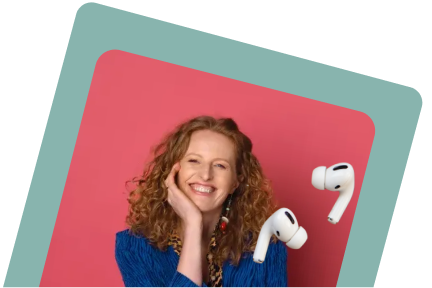
Monika Bielskyte is the founder of Protopia Futures and currently serves as Futurist in Residence at Nike (Embodied Futures: Storyworld Design and Strategy). She is also a futurist advisor to Climate Spring and Inclusive AI Lab, as well as a member of EY’s Luminary Expert Circle.
In this Talk on Creativity, Monika unpacks what it truly means to be a futurist—exploring how our values, stories, and sensory experiences shape the futures we design. From life-centric design to prototyping futures, she reveals how creativity can move beyond technological hype to imagine futures grounded in humanity, interdependence, and care for all life.
Let’s dive in!
Listen to this Episode on Bloomerangas Podcast 🎙️
Subscribe to the Bloomerangas Podcast



What Does It Mean to Be a Futurist?
As a futurist Monika has worked on Disney Marvel’s Black Panther Wakanda Forever and her past clients include Google, Microsoft, World Economic Forum, DreamWorks, BBC among others. She has given lectures at CERN, Rockefeller University and Royal Society among others.
Her work redefines what it means to think about the future—grounding speculation in embodiment, inclusion, and lived experience. Monika advocates for innovation that is compassionate, resilient, and informed by the diversity of human perception and ability.
For Monika, being a futurist is not about predicting trends or glorifying technology—it’s about understanding how our values, narratives, and histories shape the futures we create. The role demands deep engagement with the past as much as with what’s next. A true futurist, she says, must ask: What kind of future do we actually want to inhabit?
“Future doesn’t happen to technology—it happens to our bodies,” Monika explains. To her, innovation is not just technical progress; it’s about how advancements impact our physical, mental, and ecological well-being. Technology is an extension of our bodies and minds, but our collective future depends on how we choose to use it.
Being a futurist also means making people uncomfortable. Monika believes futurists shouldn’t merely inspire—they should challenge assumptions and provoke critical reflection.
From Trend Forecasting to Systemic Foresight
Monika’s process begins with extensive research—around 90% of her work, she notes, is dedicated to studying insights from experts working at the bleeding edge of science and culture. But her goal isn’t to simply collect data; it’s to connect patterns across disciplines and uncover their wider social implications.
In her view, most corporate futurism stops at trend forecasting, creating glossy visions without addressing their societal impact. Her work, instead, focuses on foresight—understanding not only what’s probable, but also what’s desirable. If the trajectory we’re on doesn’t lead to a future worth inhabiting, she asks, how can we reshape it?
A key part of her method is helping organizations see beyond what’s immediately profitable or familiar. She encourages companies to anticipate long-term systemic change rather than react to short-term market forces. This means designing for resilience, not just efficiency.
Life-Centric Design and the Future of Innovation
Monika advocates for what she calls life-centric design, a framework that moves beyond user- or human-centered approaches. As she explains, true innovation must take into account the interdependence of all life forms:
“We need to understand how human success—in our health, economy, and creativity—is intertwined with the flourishing of the ecosystems we depend on.”
In her collaborations, Monika urges teams to think of innovation as a long-term relationship with the living world. This perspective challenges extractive, short-term thinking and pushes for products and systems that sustain both people and the planet.
She contrasts this with the outdated idea of user-centered design—a model she likens to addiction, where consumers are treated as “users” in the same sense as drug users. Instead, she calls for a paradigm shift toward designing with life, emphasizing collaboration, adaptability, and co-creation.
The Power of Story Worlds
Before working with global corporations, Monika spent years in the entertainment industry developing story worlds for sci-fi films and media. She describes projects like Black Panther and Avatar as examples of powerful world-building: universes so vivid and coherent that they transcend fiction and shape real-world imaginations.
Monika sees immense potential in bringing this practice to real-world contexts—cities, brands, and policies. In an age where words are easily misinterpreted, she believes story worlds can communicate complex ideas in ways that verbal manifestos cannot.
“The challenge is to make hopeful futures as compelling and sticky as the fear-driven narratives that dominate our media.”
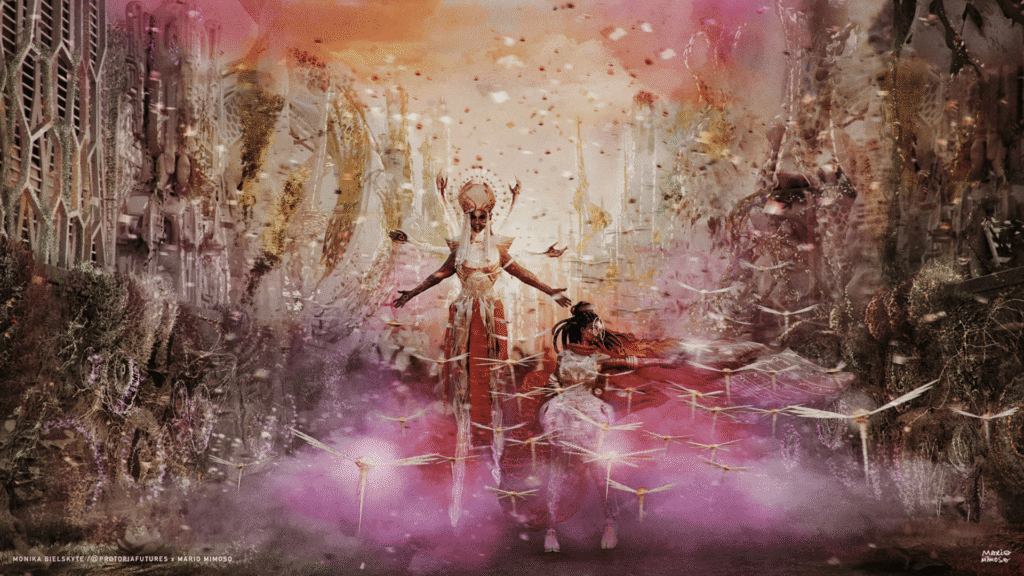
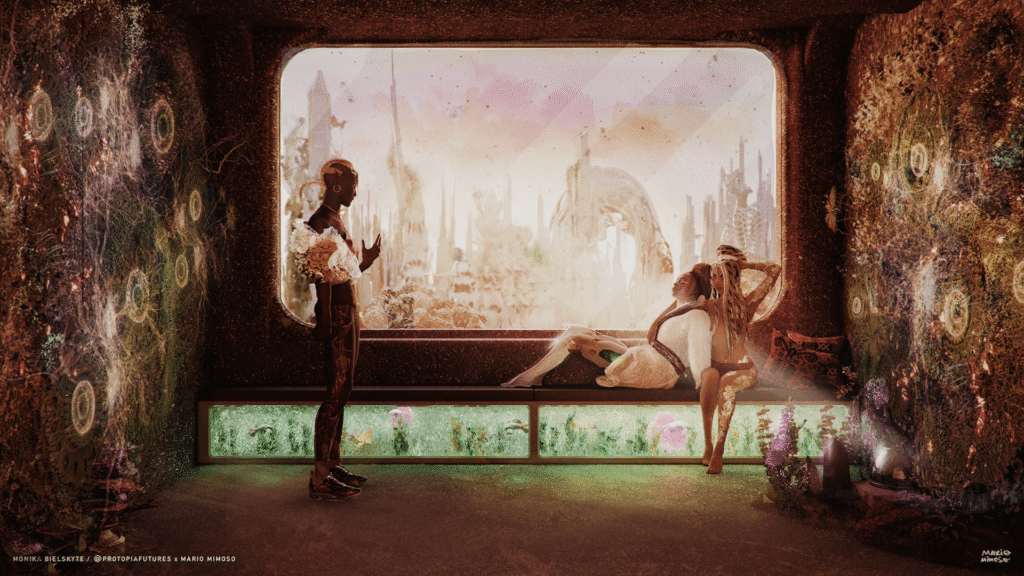
Through her Protopia Futures Design Framework, Monika helps organizations craft visions that are science-informed, realistic, and hopeful. Unlike utopias or dystopias—which she sees as static and exclusionary—Protopias are dynamic and evolving. They acknowledge imperfection yet strive for continual improvement.
From Dystopia to Protopia
To imagine better futures, Monika suggests organizations practice scenario prototyping—envisioning multiple futures side by side. This involves juxtaposing dystopian possibilities with protopian ones, identifying vulnerabilities while outlining hopeful, data-informed alternatives.
This process is not limited to large institutions; she insists that every organization, regardless of size, can engage in future prototyping. Even small teams can envision what resilience, inclusivity, and regeneration might look like in their context.
Protopian thinking, she notes, is both pragmatic and aspirational—it’s about acknowledging challenges while taking concrete steps toward a more equitable, sustainable world.
Rethinking Progress: Biology as the New Frontier
Monika argues that the future frontier is biological, not digital. While 20th-century sci-fi celebrated rockets and silicon, the true innovation now lies in understanding life itself. DNA-based data storage, biomaterials that self-repair, and research into interspecies communication all point to a new paradigm—one that aligns more closely with indigenous worldviews emphasizing interconnectedness and observation.
“Life has always been the most advanced technology,” she says. Recognizing that truth could shift how we define progress—from domination to symbiosis, from extraction to cohabitation.
Embodiment, Accessibility, and Inclusive Futures
Much of Monika’s recent research explores embodiment—how our sensory and physical experiences shape the way we design and innovate. Drawing from her own experience with neurodivergence and sensory processing differences, she advocates for accessibility-driven innovation. She observes that solutions created for marginalized or disabled communities often end up improving life for everyone.
“Accessibility-based innovation doesn’t just help the disabled—it results in better design for the majority.”
This approach, she argues, could revolutionize how we think about health, technology, and urban environments. By prioritizing inclusive, embodied perspectives, we build systems that support human and planetary well-being simultaneously.
How We Communicate the Future
In Monika’s view, the way we talk about the future is just as important as the future itself. Hopeful storytelling requires creativity, research, and deep collaboration. Without engaging narratives, even the best ideas risk being overshadowed by fear and misinformation.
She calls for artists, scientists, and technologists to unite—to become “nerds and imagineers” working together to make optimistic visions not just credible, but irresistible.
Creativity and the Professions of the Future
When asked what professions or brands will define the future, Monika emphasizes adaptability, critical thinking, and empathy. “Never design for, always design with,” she advises. The future will belong to those who can bridge disciplines, think systemically, and engage with complexity rather than simplify it.
She believes creativity will play a vital role—not as decoration, but as a form of problem-solving rooted in awareness and care. Professions that merge imagination with science, storytelling with data, and ethics with design will thrive.
“Everything about the future that cannot be automated will be tied to our imagination, empathy, and ability to see what’s missing.”
For Monika, creativity is both a tool and a responsibility. It’s how we connect with life, question assumptions, and expand what’s possible. “To me,” she concludes, “the future is not about better machines—it’s about better relationships: with ourselves, with each other, and with the world that sustains us.”